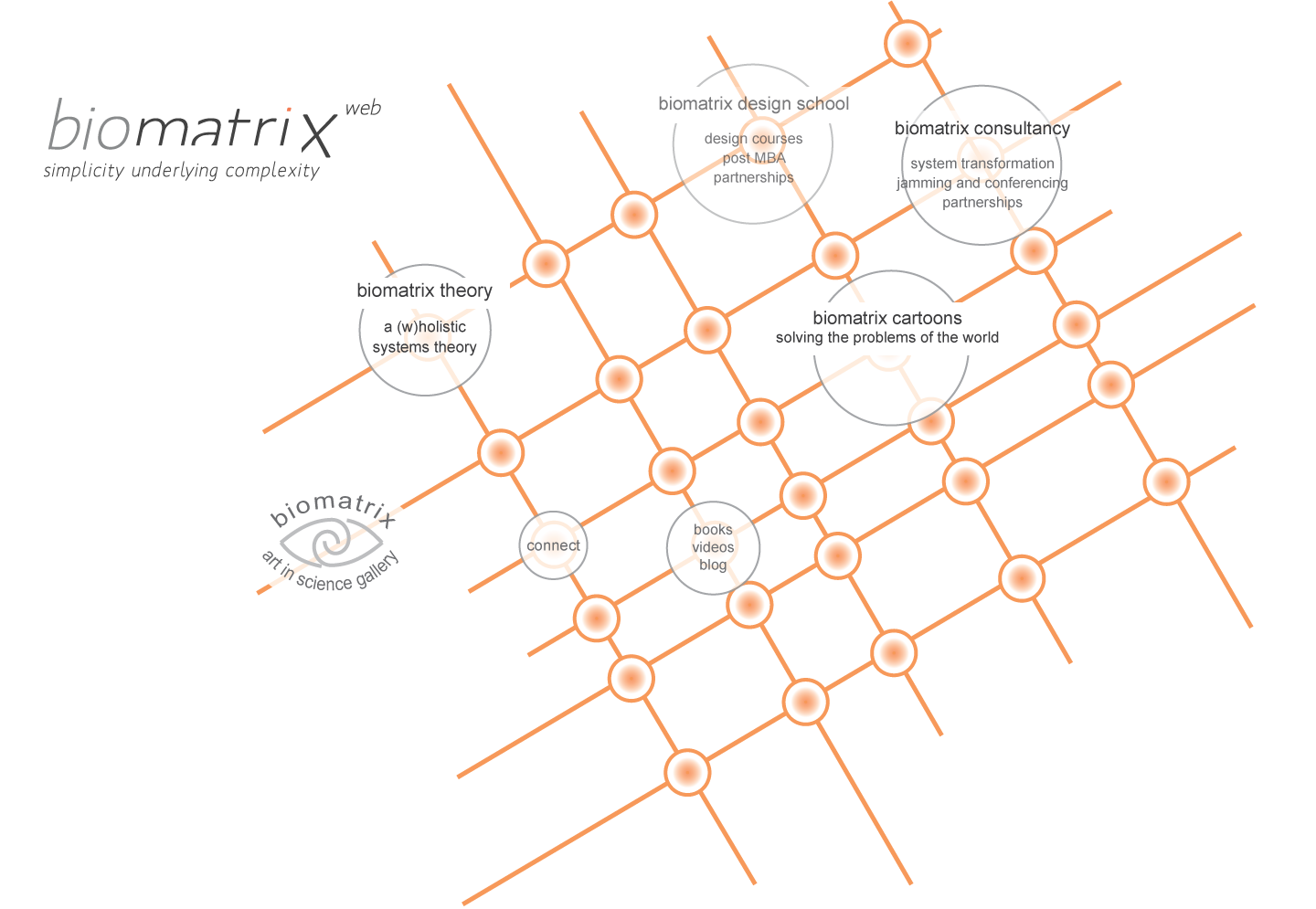
biomatrix web

BiomatrixWeb is an education and consulting business with a difference:

  • We specialise in systemic management solutions grounded in Biomatrix systems theory. (An overview of the theory is provided on a dedicated webpage biomatrixtheory.com.)
  • Our education programmes are a synergistic blend of e-learning and action learning. They change the worldview of managers and leaders and provide them with theoretical knowledge, practical methods and skills to solve complex problems, transform organisations and change societies.
  • Action learning is relevant because it applies knowledge to the learner’s organisational context as case study.
  • Our unique consulting approach is education driven.  As select leaders of an organisation participate in the education programme, they design the necessary change interventions that – if implemented – transform their system.

biomatrix programmes

biomatrix management education programme

This is a programme for systemic management education. It transforms learners into systems thinkers and provides them with practical systemic project management, organisation development and change management skills.

Ideally, all MBA, organisation development, executive and management development and change management programmes should incorporate a course in systems thinking.

read more

biomatrix organisation transformation programme

This is a programme for systemic organisational transformation, driven by education. It enables an organisation to restructure itself for ongoing learning and change in response to its changing environment. It educates a cadre of systems experts who – in the course of the education – redesign the organisation and facilitate its transformation into a systemic learning organisation. Systemic problems throughout the organisation get dissolved. Using education as a driver of change ensures that the transformation is lasting and sustainable.

Ideally, each private and public sector organisation becomes a systemic learning organisation, structured as a three-dimensional matrix for optimal internal coordination and connectivity with stakeholders in the global environment.

read more

biomatrix societal transformation programme

This programme uses education of public policy and change facilitators in systemic problem dissolving to drive ideal redesign of public policies, industry governance, supply chains, delivery of public goods and services and public debates. It also enables the facilitators to redesign government departments, public and private sector partnerships and industry bodies associated with the design.

BiomatrixJam, a unique online methodology that facilitates contributions from stakeholders and allows a structured public debate, is one of the key components of the programme.

Ideally, all change interventions in the public sector use frameworks, principles and methods derived from Biomatrix systems theory and use the BiomatrixJam for problem analysis and the brainstorming of creative solutions.

read more

unique features of the programme

underlying systems theory

Research shows that two thirds of organisational change interventions fail. The main reason for this is that they are not designed systemically.

Unfortunately systems thinking is not the dominant worldview of current management education and practice.

By comparison, the Biomatrix programmes are grounded in the Biomatrix Systems Approach. This approach consists of a coherent systems theory and methodology that integrates the key concepts, tools and methods of various other systems theories with its own, and applies them to complex problem (dis)solving, organisation development and transformation, as well as public policy design.

It provides an overarching systemic theoretical and methodological framework which contextualises conventional management models, approaches and tools. Within their appropriate context, they are useful and can make valuable contributions. If they are applied outside of it, they become management fads. In interaction with a systemic approach, they become coordinated and synergistic.

welcoming problems as opportunities for change

One of the reasons why complex organisational and societal problems cannot be solved is that they are systemic. This means that they are co-produced by other systems, are multi-dimensional, involve circular causation, change in the course of time and involve emergence. They cannot be solved by the system which experiences them but require the cooperation of their co-producing systems. They also cannot be solved in the conventional problem solving manner. Trying to do so merely creates frustration and demotivation, adding more problems to the already existing ones. Once this systemic complexity is understood, blame and guilt disappear.

Systemic problems can only be dissolved. This requires a shift in logic and fundamental changes (i.e. a transformation) in the systems that co-produce the problems. If one understands this and knows how to manage this, problems become an opportunity. They become the source of imagination, creativity, innovation and the ability of the system to reinvent itself. They are actually liberating! The more problem riddled a system is, the easier it is to transform it. (One cannot change a perfect system!)

The Biomatrix programmes use the problems of the system as opportunities for transforming it and as a motivator for its members to become creative and embrace change.

education as driver of change

Another reason for unsuccessful or abandoned change interventions is resistance to change by the members of the system. The reasons are that they do not see the need for change, do not understand it, do not participate in the design of the intervention and feel threatened by any change to the status quo.

The Biomatrix programmes use education to transfer knowledge of systems theory and methodology. During the education process, the delegates understand the need for change, design systemic interventions and through facilitating their implementation transform the system.

Because the designs are made in the context of education, there is no a priori resistance to them. By the time they are actually implemented, stakeholders have already been involved in design iterations, have changed their mindset in support of the design and organisational culture has become more systemic, making the change sustainable.

development of internal consultants

Many organisations suffer from too many uncoordinated change interventions to solve problems, improve performance, or merely to follow the “flavour of the month” change.

A change intervention is typically initiated by a part of the system with the aim of improving it, without synchronising it with other parts and the organisation as a whole. The benefit of an uncoordinated intervention – even if initially beneficial – does not last and a new intervention is required. Some interventions even cause new problems, yet rarely do organisations learn from this.

Multiple interventions in an organisation typically involve different external consultants who act independently from each other. They introduce change based on their preferred models and methods, without thorough understanding of the specific needs and history of the larger organisational or societal context.

The Biomatrix programmes train a cadre of in-house systems experts that learn about all aspects of systemic problem dissolving, functional and organisational intervention design and change management.  Being familiar with the overarching theoretical and methodological framework of the Biomatrix systems approach, they can choose, evaluate and customize any change intervention. They can either facilitate the design and implementation of interventions or coordinate external consultants to do so, ensuring the synergistic and coherent development of their organisation and its functional parts.

involving stakeholders in the change

Often interventions fail because key stakeholders were not considered, consulted or involved.

The Biomatrix programmes require stakeholder input in all phases. They also build the education of, feedback to and interaction with stakeholders into the programme, including a diagnostic stakeholder survey and stakeholder involvement in design iterations and implementation planning. This ensures that stakeholders actually co-produce the learning organisation and implement their share of the strategic design for dissolving the problems they co-produce.

wiring the system for ongoing change

In the global information age economy, the business environment of an organisation is constantly changing, forcing the organisation to change accordingly. Unless systems learn to change rapidly and with ease, they become diseased and burn out.

Systems thinking enables an organisation to manage the paradox of ongoing change without losing stability. The Biomatrix programmes create the stable structures that wire an organisation for ongoing change. This involves the

  • creation of an ideal design of the organisation and its functional parts which inspires ongoing development in the context of a continuously changing environment
  • incorporation of systems thinking in the culture of the organisation
  • setting up of organisational structures that ensure optimal coordination and process flow (e.g. a three dimensional organisational matrix, coordinated planning forums)
  • establishment of governance frameworks, coordinated strategic and operational planning and management procedures, as well as connectivity with the environment
  • entrenching of ongoing learning and knowledge management (e.g. through knowledge repositories and procedures) in a self-referring manner.

benefits and outcomes of the programmes

The programmes produce the following beneficial outcomes. They

  • create an ideal design for the system to act as continuous inspiration
  • transform the system if the designs and plans developed during the programme are implemented
  • wire the system for ongoing learning and development based on generic systemic organising principles
  • transfer knowledge into the organisation thereby ensuring that the change intervention is sustainable
  • develop a cadre of systems experts who understand systemic problem dissolving, management and governance and apply this in their own sphere of influence and who also can act as internal consultants to their organisation and even as external consultants to their stakeholders
  • change organisational culture to support systemic problem dissolving, ideal design and synergistic stakeholder interaction
  • build on the strengths and past successes of the system, thereby focusing the system on its uniqueness
  • enhance the creativity of the members of the system, innovation and organisational learning
  • identify and dissolve problems throughout the system and in the interaction with stakeholders.